Introduction
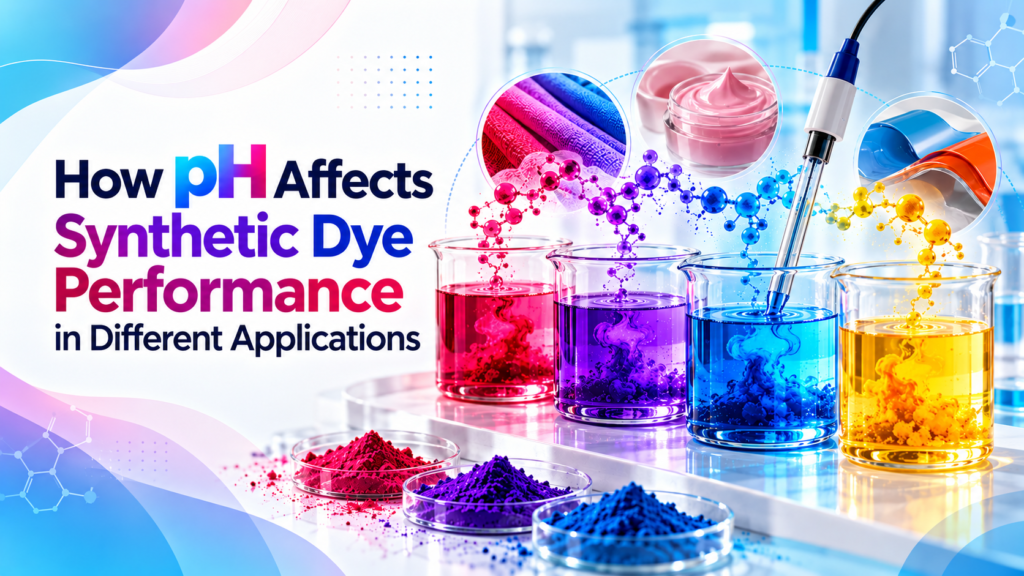
pH is one of the most important process conditions when using synthetic dyes. A small pH change can affect dye solubility, dye uptake, color strength, shade development, leveling, and, in some cases, dye stability.
However, no single pH value works for every synthetic dye. Acid dyes, reactive dyes, disperse dyes, and other dye classes have different chemical structures and application requirements. The substrate also matters. A pH that works well for wool may not suit polyester or cotton.
For manufacturers and industrial buyers, controlling pH is therefore not simply about choosing an acidic or alkaline bath. It is about matching the dye chemistry and application process to the correct operating range.
Why Does pH Matter in Synthetic Dye Applications?
pH changes the chemical environment in which a dye interacts with water, auxiliaries, and the substrate
Depending on the dye system, pH can influence:
- Dye solubility and dispersion
- Dye-fiber attraction
- Dye uptake and exhaustion
- Reaction between dye and fiber
- Color strength and shade
- Leveling and migration
- Dye stability during processing
- Final color fastness
This is why uncontrolled pH can result in uneven shades, lower color yield, poor reproducibility, or unwanted changes during processing.
The exact effect, however, depends on the dye structure. Research on disperse dyes, for example, shows that pH can influence dyeing behavior differently depending on the individual dye structure rather than following one universal pattern.
pH and Acid Dyes
Acid dyes are commonly used on substrates such as wool, silk, and nylon. In these systems, an acidic dye bath can increase the number of positively charged sites on the fiber.
The negatively charged groups in many acid dyes can then interact with these positively charged sites, promoting dye uptake.
The required pH depends on the specific acid dye and substrate. Some acid dyeing processes operate under strongly acidic conditions, while others use milder acidity. For example, educational textile references describe wool dyeing processes using ranges such as pH 2.5–3.5 or 3.5–4.5 depending on the acid system.
This means that simply increasing acidity does not automatically improve performance. Excessively rapid dye uptake can also make leveling more difficult.
pH and Reactive Dyes
Reactive dyes are widely used for cellulose fibers such as cotton because they can form covalent bonds with the fiber.
Here, pH has a particularly important role. Alkaline conditions promote the reaction between the reactive dye and cellulose. At the same time, the dye can also react with water, producing hydrolyzed dye that no longer bonds effectively with the fiber.
Therefore, pH control must balance fixation with the risk of unwanted hydrolysis.
After dyeing, thorough washing and soaping remove unfixed and hydrolyzed dye. Poor removal can negatively affect rubbing and washing performance.
For reactive dyeing, treat pH as a controlled process parameter rather than something adjusted only after a shade problem appears.
pH and Disperse Dyes
Disperse dyes are commonly used for polyester and other hydrophobic synthetic fibers. Unlike many water-soluble dyes, disperse dyes have very low water solubility and are applied as fine dispersions.
Commercial polyester dyeing is generally performed under mildly acidic conditions. Depending on the dye and process, commonly reported working ranges are around pH 5–6.5.
pH control helps maintain suitable dyeing conditions, but don’t assume every disperse dye behaves the same way.
Research has shown that some disperse dyes can show different color strength at different pH values. In some cases, increasing pH can reduce color yield or even contribute to dye degradation, while individual dye structures may respond differently.
That is why dye suppliers should provide application recommendations for each product instead of relying on a general polyester dyeing recipe.
What Happens When pH Is Not Controlled?
Poor pH control can create several practical problems:
Uneven dyeing: Rapid or inconsistent dye uptake can produce patchy shades.
Shade variation: Changes in dye ionization, uptake, or stability can shift the final shade.
Lower color strength: Incorrect pH can reduce effective dye absorption in some systems.
Poor reproducibility: A process may produce one result in the laboratory and another in production if bath pH changes.
Dye degradation: Some dye structures are sensitive to strongly acidic or alkaline conditions.
Lower fastness: If fixation or removal of unfixed dye is poor, washing or rubbing performance can suffer.
These effects don’t apply to every synthetic dye. You must evaluate them for the specific dye, substrate, temperature, concentration, and process.
How to Control pH During Dyeing
Good pH control starts before you add the dye.
1. Check the starting water
Water quality and its natural pH can influence the dye bath. Hardness, alkalinity, and other dissolved materials can also affect the process.
2.Use suitable pH regulators
Select acids, alkalis, or buffer systems based on the dye class and process requirements. Buffering can help prevent sudden pH changes during dyeing.
3.Monitor pH during the process
Measuring pH only at the beginning may not be enough. Chemicals consumed during processing can change the bath conditions.
4.Follow the dye supplier’s technical data
Consider the recommended pH range along with temperature, dosage, auxiliaries, and substrate.
5.Validate at laboratory scale
Before production, compare shade, color strength, exhaustion, leveling, and fastness at different controlled pH values.
What Should Buyers Ask Synthetic Dye Manufacturers?
When sourcing synthetic dyes, buyers should ask for more than the product name and shade.
Useful technical information includes:
- Recommended pH range
- Suitable substrates
- Recommended dye concentration
- Temperature range
- Compatibility with common auxiliaries
- Dye stability under processing conditions
- Recommended storage conditions
- Relevant fastness properties
- Batch-to-batch consistency
- Application and technical data sheet
For businesses evaluating dyes manufacturers in India, these technical details can be more useful than comparing price alone. A lower-cost dye that requires difficult process corrections may raise production costs through rework, shade rejection, and additional processing.
Conclusion
pH is critical to synthetic dye performance, but its effect depends heavily on dye chemistry and application.
Acid dyes generally require acidic conditions to interact effectively with suitable fibers. Reactive dyes require controlled alkaline conditions for fixation but are also vulnerable to hydrolysis. Disperse dyes used on polyester are commonly applied under mildly acidic conditions, although individual dyes can respond differently to pH.
The practical approach is simple: do not choose a pH based only on the dye class. Match the pH to the specific dye, substrate, and application process, then verify the result through controlled testing.
For manufacturers and buyers seeking consistent synthetic dye performance, include technical specifications, process support, and batch consistency in supplier evaluation.
Looking for synthetic dye solutions for your application? Contact Hridhan Chem to discuss your product requirements and application needs.
FAQs
Yes. Depending on the dye chemistry, pH can affect dye uptake, color strength, stability, fixation, leveling, and final fastness.
No single pH works best for all synthetic dyes. The appropriate range depends on the dye class, substrate, temperature, auxiliaries, and application method.
Reactive dyes generally require alkaline conditions to fix effectively to cellulose. Excessive or poorly controlled alkalinity can also increase dye hydrolysis.
Disperse dyeing of polyester is commonly carried out under mildly acidic conditions, often around pH 5–6.5. Confirm the exact range for the specific dye and process.
Yes. pH changes can affect dye uptake, stability, and color strength, which may cause shade variation. However, the degree of change depends on the specific dye and application.
Buyers should check the recommended pH range, substrate compatibility, application conditions, stability, fastness data, technical documentation, and batch consistency rather than evaluating a dye only by price.