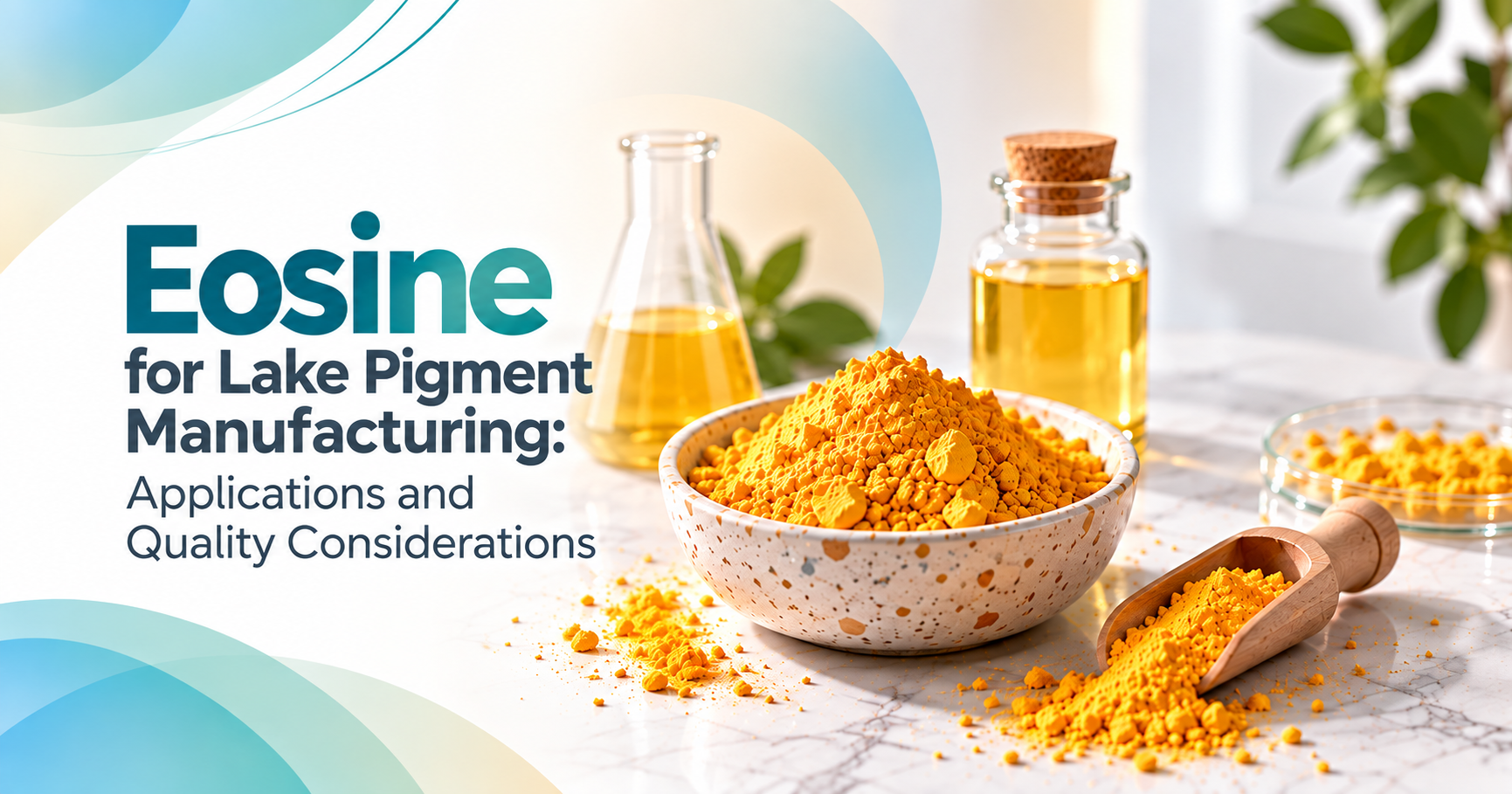
Eosine for Lake Pigment Manufacturing | Applications & Quality
Introduction Eosine is a synthetic dye known for its bright pink to red shades. It is also used as a starting material for lake pigment manufacturing, where a soluble dye is converted into an insoluble pigment by combining it with a suitable substrate or metal-based system. This distinction is important for manufacturers and buyers. Eosine itself is a dye, while an eosine lake is a pigment. The final properties of an eosine lake depend not only on the dye but also on the substrate, precipitation conditions, particle size, washing, drying, and milling process. For a lake pigment manufacturer, controlling these variables is essential for producing consistent shade, strength, dispersion, and purity. What Is Eosine Lake Pigment? Eosine refers to a group of related xanthene dyes. Eosin Y, also called Acid Red 87 or D&C Red No. 22, is one important example. Eosin Y is a brominated fluorescein derivative and is commonly supplied as its disodium salt. A lake pigment is produced by converting a soluble dye into an insoluble pigment form through interaction with a substrate or precipitating system. The substrate can affect the pigment’s final color and physical behavior. Research on eosin-based lakes has shown that the metal or
Eosine for Lake Pigment Manufacturing | Applications & Quality Read More