Introduction
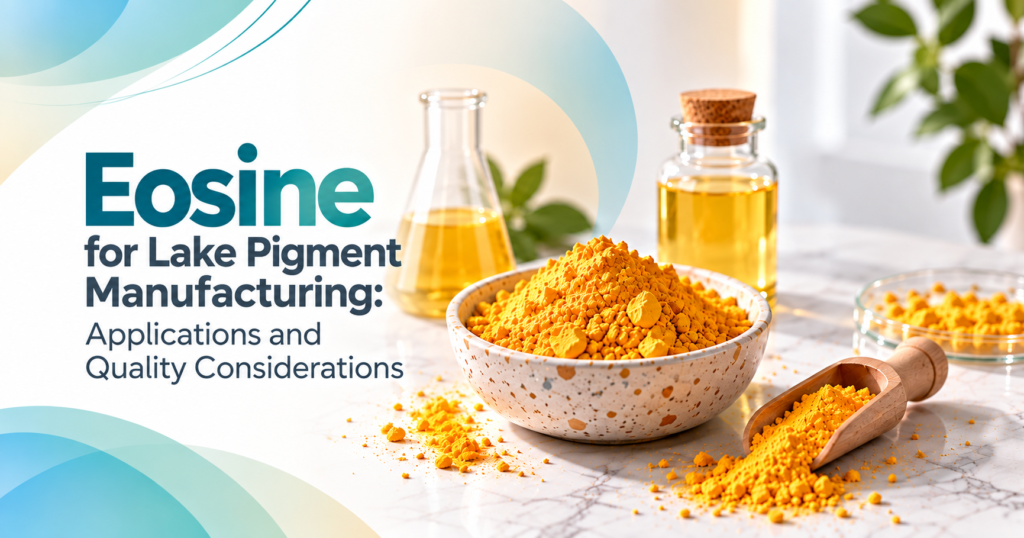
Eosine is a synthetic dye known for its bright pink to red shades. It is also used as a starting material for lake pigment manufacturing, where a soluble dye is converted into an insoluble pigment by combining it with a suitable substrate or metal-based system.
This distinction is important for manufacturers and buyers. Eosine itself is a dye, while an eosine lake is a pigment. The final properties of an eosine lake depend not only on the dye but also on the substrate, precipitation conditions, particle size, washing, drying, and milling process.
For a lake pigment manufacturer, controlling these variables is essential for producing consistent shade, strength, dispersion, and purity.
What Is Eosine Lake Pigment?
Eosine refers to a group of related xanthene dyes. Eosin Y, also called Acid Red 87 or D&C Red No. 22, is one important example. Eosin Y is a brominated fluorescein derivative and is commonly supplied as its disodium salt.
A lake pigment is produced by converting a soluble dye into an insoluble pigment form through interaction with a substrate or precipitating system. The substrate can affect the pigment’s final color and physical behavior. Research on eosin-based lakes has shown that the metal or substrate system can influence the coordination structure and resulting color.
Therefore, eosine lake pigment manufacturing should not be treated as simply mixing eosine with a filler. Reaction conditions and process control can directly affect the finished pigment.
Applications of Eosine Lake Pigments
Eosine-based lakes have a history of use in bright red and pink pigment applications. Historical research documents eosin lakes being used in artist materials, including products marketed under names such as “geranium lake.”
Evaluate modern applications based on the specific grade and applicable regulations.
Possible application areas can include:
- Pigment and coating applications where the required shade and stability match the formulation.
- Printing and artistic materials requiring pink, red, or related shades.
- Cosmetic applications, but only where the specific color additive, grade, purity, and use are permitted in the target market.
- Specialty pigment formulations that require controlled dispersion and shade development.
A common mistake is to assume that because eosine or an eosine-derived lake has been used historically in a particular product, the same material is automatically approved for that use today. That is not a safe assumption.
For example, the U.S. FDA lists D&C Red No. 22 as a permanently listed color additive requiring certification, with listed uses in drugs and cosmetics. Check its permitted uses and restrictions against the applicable regulation before commercial use.
Key Quality Considerations in Lake Pigment Manufacturing

1. Shade Consistency
Shade consistency is one of the first quality requirements for an industrial pigment manufacturer. Small changes in reaction conditions, substrate ratio, pH, temperature, or drying can influence the final color.
Research has shown that pH and the coordination system can affect the color of eosin-based lakes.
A reliable manufacturing process should therefore control these parameters from batch to batch.
2. Purity and Dye Content
Raw material purity can directly affect pigment performance. Buyers should request appropriate specifications and a certificate of analysis covering grade-relevant parameters.
Depending on the intended application, testing may include identity, assay or dye content, moisture, insoluble matter, heavy metals, residual salts, and other application-specific impurities.
Base the exact specification on the product grade and regulatory requirements rather than a generic checklist.

3. Particle Size and Dispersion
Particle size affects how a lake pigment behaves during processing. Poorly controlled particle size can lead to inconsistent dispersion, color strength, settling, or formulation problems.
A pigment manufacturing company should therefore have suitable milling, drying, and particle-size controls where required by the product specification.
4. Light Stability
Eosin-based pigments require particular attention to light stability. Research has documented fading and photodegradation of eosin and eosin-based lake pigments.
This does not mean every eosin lake has identical stability. Performance depends on the pigment structure, substrate, formulation, exposure conditions, and other factors.
For outdoor coatings or products exposed to strong light, buyers should request application-specific lightfastness data rather than assuming that a bright initial shade means high durability.
5. Regulatory Compliance
Regulatory compliance is critical when pigments are intended for cosmetics, drugs, food, or other regulated applications.
In the United States, FDA regulations define lakes as color additives made by extending a straight color on a substrate through processes such as adsorption, coprecipitation, or chemical combination. The permitted use of a lake depends on the specific color additive and application.
An ISO-certified pigment manufacturer may provide stronger quality-system documentation, but ISO certification alone does not prove that a particular pigment is approved for a specific regulated application. Buyers should verify both quality-system credentials and product-specific regulatory compliance.
What Buyers Should Ask an Eosine Lake Pigment Supplier
Before selecting a lake pigment manufacturer or dyes and pigments manufacturer, buyers should ask:
- What is the exact chemical identity and color index reference?
- What substrate is used for the lake pigment?
- What are the shade and strength specifications?
- What particle-size range is supplied?
- What purity and impurity limits apply?
- Is a batch-specific Certificate of Analysis available?
- What lightfastness or stability data is available?
- Is the grade suitable for the buyer’s intended application and target market?
- What quality certifications does the manufacturer hold?
- Can the manufacturer provide technical documentation and samples for evaluation?
These questions help separate a basic pigment supplier from an industrial pigment manufacturer with controlled production and quality systems.
6. Why Documentation Is Becoming More Important
Global buyers increasingly need more than a product datasheet.
Before placing a larger order, request relevant documents such as:
- Technical Data Sheet
- Certificate of Analysis
- Safety Data Sheet
- Product specification
- Regulatory statement
- Manufacturing origin
- Batch information
- Packaging details
- Shelf-life information
- Export documentation, where applicable
The required documents depend on the product and destination market.
For U.S. buyers, the supplier should provide documentation that lets the buyer confirm whether the product meets applicable color additive requirements. FDA’s regulations also specify labeling and certification information for certified color additives.
Conclusion
Eosine can serve as an important starting dye for the production of certain lake pigments, but the performance of the final pigment depends on much more than the dye itself. Substrate selection, precipitation conditions, pH, particle size, drying, milling, purity, and regulatory requirements all require consideration.
For manufacturers and buyers, the priority should be consistent quality, documented specifications, application testing, and market-specific compliance. Evaluate a supplier not only on color but also on its ability to maintain batch consistency and provide reliable technical documentation.
Looking for a Lake Pigment Manufacturing Partner?
If you are sourcing eosine-based lake pigments or other specialty pigments, evaluate suppliers based on product specifications, quality controls, documentation, application suitability, and regulatory requirements. Contact a qualified lake color manufacturing company or ISO-certified pigment manufacturer to discuss your required shade, application, specifications, and testing requirements.
FAQs
Eosine can be used as a starting dye for producing certain lake pigments. The dye is converted into an insoluble pigment form through interaction with a suitable substrate or precipitation system.
Eosine is a dye. When it is converted into an insoluble lake form through interaction with a substrate, the resulting material is considered a lake pigment.
Important factors include raw material purity, substrate selection, pH, reaction conditions, particle size, drying, milling, shade strength, and stability.
Some eosine-related color additives are approved for cosmetic use, but suitability depends on the exact chemical identity, grade, formulation, and country. In the United States, D&C Red No. 22 has specific FDA requirements and certification status.
Eosin-based materials can photodegrade and fade under light exposure. Application-specific lightfastness testing is therefore important when the pigment will face prolonged light exposure.
Buyers should check product identity, specifications, batch consistency, purity, particle size, technical documentation, quality certifications, regulatory suitability, and application test data.
No. ISO certification relates to the manufacturer’s quality-management system and does not by itself establish regulatory approval for a pigment in food, cosmetics, drugs, or other regulated applications.