Introduction
Buying synthetic dyes in 2026 is no longer only about finding a supplier with the right shade and price. Global buyers also need to look at raw material availability, production capacity, quality control, documentation, regulatory requirements, shipping, and supply continuity.
This is especially important for buyers sourcing from India. India has a large chemical and dye manufacturing base, but a supplier’s location alone does not confirm that a specific dye suits a particular market or application.
For food, pharmaceutical, cosmetic, and other regulated applications, buyers should verify each product’s exact identity, permitted use, purity requirements, and documentation. In the United States, for example, color additives must be approved for their intended use, and many synthetic colors also require FDA batch certification before they can be used in regulated products.

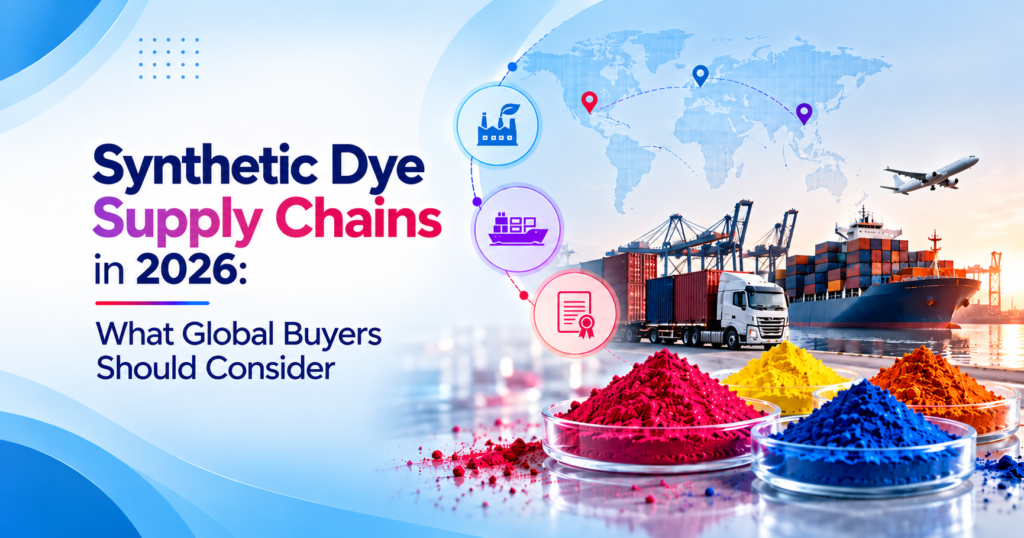
1. Understand the Complete Synthetic Dye Supply Chain
A synthetic dye supply chain normally involves several stages:
Raw materials → chemical intermediates → dye manufacturing → purification → quality testing → packaging → export documentation → shipping → customer delivery
A disruption at any stage can affect lead time, production schedules, or final cost.
For buyers, this means supplier evaluation should go beyond the final product. Ask where critical raw materials come from, whether the manufacturer has backup sources, how it tests batches, and how it handles supply interruptions.
A reliable synthetic dye supplier should be able to explain its production and quality process clearly without making unsupported claims about supply security.
2. Raw Material Availability Matters
Synthetic dyes depend on chemical intermediates and other raw materials. Changes in raw material availability can affect production cost and delivery schedules.
Buyers should therefore ask:
- Which raw materials are critical for the dye?
- Are important inputs sourced from a single supplier?
- Does the manufacturer maintain approved alternate sources?
- How are raw material changes controlled?
- Can the supplier maintain the same product specifications after a raw material change?
This is particularly important when the dye is used in a formulation where even a small change in shade, strength, purity, or solubility can affect the finished product.
3. Do Not Choose a Supplier on Price Alone
A lower quoted price does not always mean a lower total purchasing cost.
A buyer should consider:
Product price + testing + packaging + freight + duties + documentation + rejection risk + delivery time
For regulated applications, an inexpensive material that fails a specification or lacks the required documentation can create much higher costs later.
A proper supplier comparison should therefore include product specifications, minimum order quantity, lead time, payment terms, packaging, testing documents, and regulatory support.

4. Quality Control Should Be Part of the Buying Decision
For synthetic dyes, color strength alone is not enough.
Depending on the product and application, buyers may need information such as:
- Assay or total color content
- Moisture
- Insoluble matter
- Residual salts
- Subsidiary colors or related impurities
- Heavy metals
- Appearance and shade
- Solubility
- Batch-to-batch consistency
The exact requirements depend on the dye and its intended use.
For U.S. FDA-certifiable color additives, FDA evaluates factors including purity, moisture, residual salts, unreacted intermediates, subsidiary colors, specified impurities, and certain heavy metals.
That is why buyers should request a current Certificate of Analysis (CoA) and compare it with the agreed specification, rather than relying only on a supplier’s product description.
5. FD&C and D&C Dyes Need Extra Regulatory Attention
The terms FD&C dyes and D&C dyes are often used in searches for food, drug, and cosmetic color additives. However, buyers should not treat these terms as a general quality label.
In the United States, FDA regulations specify which color additives are permitted, for which applications, and under what restrictions. Some colors require batch certification.
For certifiable colors, the certification applies to the specific batch. FDA assigns a certification lot number after the batch meets the applicable requirements.
Therefore, a buyer searching for an FD&C dyes manufacturer or D&C dyes manufacturer should verify:
- The exact legal color name.
- The intended application.
- The applicable FDA regulation.
- Whether batch certification is required.
- The certification status and documentation of the actual batch.
A CI number, E number, or generic chemical name should not automatically be treated as proof of FDA certification. FDA specifically warns against confusing these identifiers with certification status.
6. Why Documentation Is Becoming More Important
Global buyers increasingly need more than a product datasheet.
Before placing a larger order, request relevant documents such as:
- Technical Data Sheet
- Certificate of Analysis
- Safety Data Sheet
- Product specification
- Regulatory statement
- Manufacturing origin
- Batch information
- Packaging details
- Shelf-life information
- Export documentation, where applicable
The required documents depend on the product and destination market.
For U.S. buyers, the supplier should provide documentation that lets the buyer confirm whether the product meets applicable color additive requirements. FDA’s regulations also specify labeling and certification information for certified color additives.
7. India as a Sourcing Market
Verify the Manufacturer, Not Just the Trading Company Buyers looking for dye manufacturers in India should first determine whether they are dealing directly with a manufacturer, an authorized distributor, or a trading company.
This distinction matters because manufacturing capability, testing facilities, production capacity, and documentation support can differ between suppliers.
Ask for practical evidence such as:
- Manufacturing facility details
- Product specification
- Batch CoA
- Quality control process
- Production capacity
- Export experience
- Application-specific documentation
- Sample approval process
A website listing several dyes is not enough evidence of manufacturing capability.

8. Build a Second-Source Strategy
Depending on a single supplier can create unnecessary supply risk.
For important synthetic dyes, buyers can consider qualifying a second supplier before an emergency occurs. However, buyers should not approve a second supplier only because its product has the same trade name.
The buyer should compare the actual specification, shade, strength, purity, application suitability, and regulatory status.
A second source is useful only when the alternative material has been properly evaluated and approved for the intended application.
9. Questions Global Buyers Should Ask Before Ordering
Before finalizing a synthetic dye supplier, ask:
Is this material manufactured or traded?
Can you provide a current batch CoA?
What are the key quality specifications?
Can you maintain consistent shade and strength between batches?
Which raw materials are critical to production?
What is the normal lead time?
What happens if production or shipping is delayed?
Is the product permitted for my intended application and destination market?
If FDA certification applies, can the supplier provide the relevant certification information?
These questions can expose supply and compliance risks before they become purchasing problems.
Conclusion
Synthetic dye sourcing in 2026 requires a broader view of the supply chain. Price, shade, and availability remain important, but buyers should evaluate them alongside quality, documentation, regulatory requirements, production capability, and supply continuity.
For buyers sourcing from India, the practical approach is simple: verify the manufacturer, define the specification, test samples, confirm the regulatory requirements for the destination market, and review batch documentation before committing to regular supply.
At Hridhan Chem, buyers can discuss their application, required dye specifications, documentation needs, and sourcing requirements with the team before placing an order.
Looking for a reliable synthetic dye supplier from India? Contact Hridhan Chem to discuss your product and application requirements.
FAQs
Buyers should check product specifications, batch consistency, CoA, raw material controls, manufacturing capability, lead time, packaging, regulatory requirements, and export documentation.
Ask whether the company is the actual manufacturer or a trader, and request product specifications, CoA, manufacturing details, quality testing information, and relevant regulatory documentation.
An FD&C dyes manufacturer supplies colors that may fall within the FDA’s regulated FD&C color additive system. However, buyers must verify the specific color, approved use, and whether FDA batch certification applie
A D&C dyes manufacturer supplies color additives designated for certain drug and/or cosmetic uses under applicable regulations. The permitted use depends on the specific color and regulation, so buyers should verify the exact product before purchase.
No. FDA approval and batch certification are different requirements. Some approved color additives require batch certification, while others are exempt.
A CoA provides batch-specific test information that can be compared with the agreed product specification. It helps buyers verify that the supplied material meets the required quality parameters.