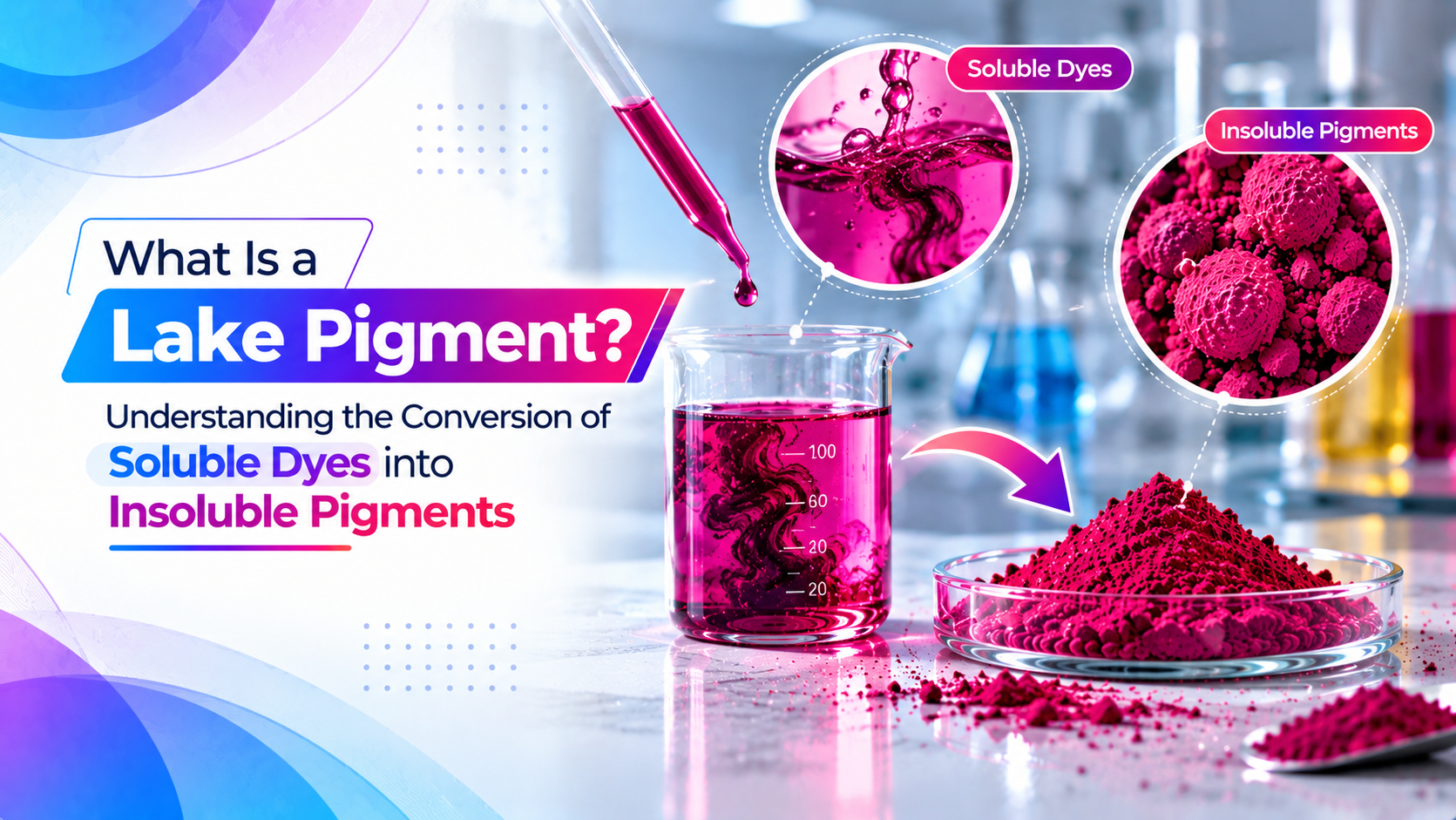
What Is a Lake Pigment? Understanding the Conversion of Soluble Dyes into Insoluble Pigments
Introduction Color plays an important role in products across several industries, from paints and coatings to plastics, printing inks, and cosmetics. However, not all colorants behave in the same way. Some dissolve in water or other liquids, while others remain as solid particles. This difference is important when choosing the right colorant for a specific application.Lake pigments are insoluble pigments made by converting soluble dyes into solid color particles. This process changes how the colorant behaves in a formulation, making it suitable for applications where a soluble dye may not provide the required performance.But how does this conversion happen? What materials are involved, and why are lake pigments used instead of water-soluble dyes?This guide explains what lake pigments are, how they are manufactured, their key properties, and the factors buyers should consider when selecting a lake pigment manufacturer. What Is a Lake Pigment? A lake pigment is an insoluble colorant produced by converting a water-soluble dye into a pigment through a controlled chemical process. The dye is combined with a suitable precipitant and, in many manufacturing processes, an insoluble substrate. The process reduces the dye’s solubility and forms solid colored particles that can be separated, processed, and used in different