Introduction

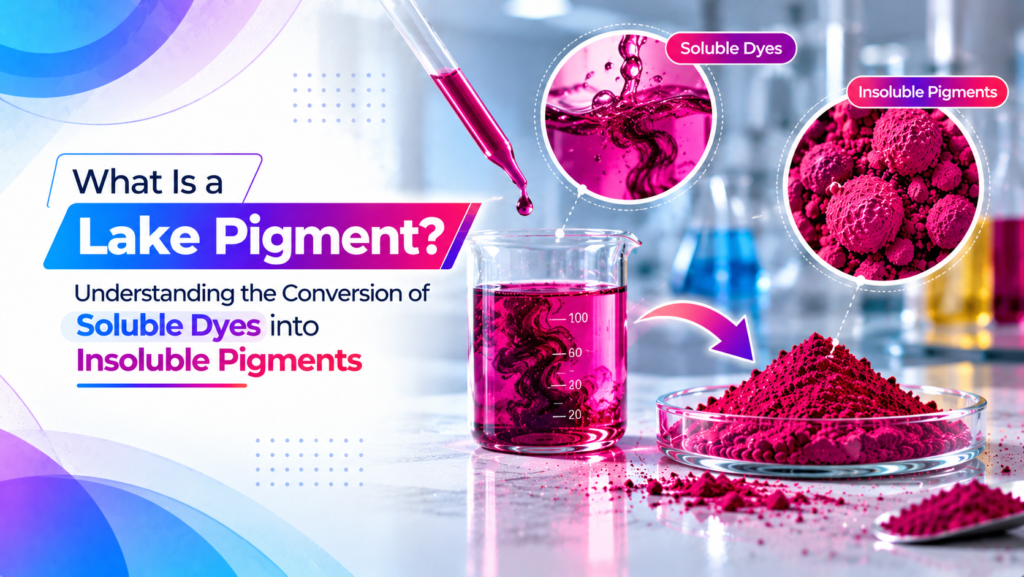
What Is a Lake Pigment?
How Are Soluble Dyes Converted into Insoluble Lake Pigments?
- Selection of the Soluble Dye
The first step is selecting a suitable water-soluble dye. The dye determines the basic color and contributes to the final pigment’s chemical and performance characteristics.
Manufacturers evaluate factors such as dye purity, chemical structure, color strength, and compatibility with the intended precipitation system.
- Preparation of the Dye Solution
The selected dye is dissolved in water or another suitable processing medium to create a uniform solution.
Proper dissolution is important because it helps maintain consistent processing conditions and supports uniform pigment formation.
- Addition of the Precipitant and Substrate
A suitable precipitant and substrate are introduced under controlled conditions.
The precipitant helps convert the soluble dye into an insoluble form, while the substrate provides a surface onto which the colorant can be deposited or incorporated.
Depending on the chemistry, the dye may attach to the substrate through adsorption, coprecipitation, or chemical combination.
- Precipitation and Pigment Formation
As the reaction progresses, the soluble colorant forms an insoluble colored material.
Important processing factors include pH, temperature, concentration, addition rate, and mixing conditions. These factors can influence particle formation, color strength, and product consistency.
- Filtration, Washing, and Drying
The resulting pigment is separated from the liquid through filtration or another suitable separation method.
Washing helps remove unwanted soluble salts and residual processing materials. The pigment is then dried under controlled conditions.
- Grinding and Quality Testing
The dried material may be milled or processed to achieve the required particle characteristics.
Quality testing checks important parameters such as shade, color strength, moisture, purity, particle size, and application-specific performance.
The final product is released against its agreed technical specifications.
Lake Pigments vs. Water-Soluble Dyes: What Is the Difference?
| Parameter | Lake Pigments | Water-Soluble Dyes |
|---|---|---|
| Solubility | Insoluble under normal use conditions | Dissolve in suitable liquids |
| Physical form | Solid pigment particles | Molecularly dissolved colorant |
| Dispersion | Requires suitable dispersion | Does not require pigment dispersion |
| Processing | Produced through precipitation or related processes | Used in soluble form |
| Formulation behavior | Remains as dispersed particles | Distributes through the liquid phase |
| Typical selection factor | Particle properties and dispersion | Solubility and compatibility |
Key Properties of Lake Pigments
- Insolubility: Lake pigments are designed to remain in solid form rather than dissolve like their original soluble dyes.
- Color strength: The amount of colorant incorporated and the manufacturing conditions influence the final color strength.
- Particle size: Particle size and distribution affect dispersion, surface appearance, and formulation performance.
- Shade consistency: Controlled manufacturing helps maintain consistent color between production batches.
- Purity: Residual salts, unreacted materials, and other impurities must be controlled according to product requirements.
- Application compatibility: The pigment must perform appropriately in the intended formulation and processing conditions.
Where Are Lake Pigments Used?
- Plastics and coatings: Selected pigment grades can provide color in suitable polymer and coating formulations.
- Printing inks: Lake pigments may be used in certain ink formulations where their shade and dispersion properties meet application requirements.
- Cosmetics: Approved lake color additives are used in specific cosmetic products, subject to applicable regulations and permitted-use restrictions.
- Food and pharmaceutical products: Certain regulated lake color additives are permitted for specific uses, subject to applicable purity, certification, and labeling requirements.
What Should Buyers Look for in a Lake Pigment Manufacturer?
- Manufacturing consistency: Check whether the manufacturer follows controlled production procedures to maintain batch-to-batch consistency.
- Technical specifications: Review the product’s shade, color strength, particle size, moisture, and purity requirements.
- Quality control: Ask about testing methods, quality documentation, and batch traceability.
- Application suitability: Confirm that the pigment grade is appropriate for the intended formulation and processing conditions.
- Regulatory documentation: For food, drug, and cosmetic applications, verify the applicable approvals, certifications, and permitted-use conditions.
- Technical support: A capable supplier should provide product information and help address formulation-related questions.

Conclusion
FAQs
A lake pigment is made by converting a soluble dye into an insoluble colorant using a suitable precipitant and, depending on the process, an insoluble substrate such as alumina or aluminum hydroxide.
Lake pigments are generally manufactured through dye solution preparation, controlled precipitation, filtration, washing, drying, and grinding. The exact process depends on the dye chemistry and required product specifications.
A soluble dye dissolves in a suitable liquid, while a lake pigment remains as solid particles. Lake pigments are used when an insoluble colorant is required in a formulation.
Aluminum-based compounds are used in many lake pigment processes because they can help convert suitable soluble dyes into insoluble pigment forms. Aluminum hydroxide or alumina may also act as a substrate.
Certain lake pigments are permitted for specific food and cosmetic applications, depending on the color additive, composition, purity, and applicable regulations. Not every lake pigment is approved for these uses.
Buyers should evaluate manufacturing consistency, technical specifications, purity, quality testing, regulatory documentation, and application suitability before selecting a manufacturer.