Introduction
Synthetic dyes are used across different industries, including pharmaceuticals, cosmetics, laboratory research, and specialty chemical manufacturing. However, similar dye names can confuse buyers when they compare chemical identity, solubility, and intended applications.
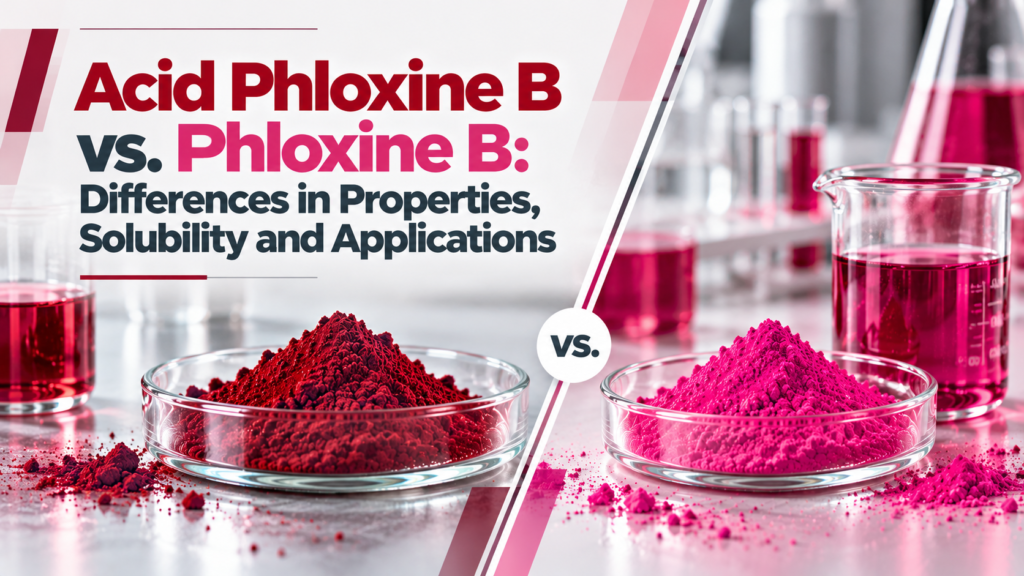
Acid Phloxine B and Phloxine B are examples where understanding the chemical form is important. Phloxine B is also known as Acid Red 92, C.I. 45410, and D&C Red No. 28. It is a synthetic xanthene dye with a bright red color.
The main point is that these names do not always refer to two separate commercial dyes. Phloxine B generally refers to the disodium salt, while Acid Phloxine B may be used in supplier descriptions for related acid-form products. Buyers should check the CAS number and chemical composition before comparing them.
This guide explains their chemical identity, properties, solubility, applications, and important sourcing considerations.
1. What Is Acid Phloxine B?
Acid Phloxine B is a name used in some chemical product listings for phloxine-related dye materials. However, the name alone does not establish whether the material is the free-acid form or the disodium salt.
The corresponding free-acid form is associated with CAS No. 13473-26-2, while Phloxine B disodium salt is identified by CAS No. 18472-87-2.
Before purchasing, manufacturers and distributors should confirm:
- Chemical name and molecular structure.
- CAS registration number.
- Salt or free-acid form.
- Color strength and purity.
- Solubility in the intended medium.
- Batch-specific Certificate of Analysis (COA).
These details help prevent confusion between products sold under similar trade or chemical names.
2. What Is Phloxine B?
Phloxine B is a synthetic xanthene dye known for its strong red color and fluorescent properties. Its chemical name is 2′,4′,5′,7′-tetrabromo-4,5,6,7-tetrachlorofluorescein disodium salt.
Key identification details include:
- CAS Number: 18472-87-2
- Color Index Number: C.I. 45410
- Other names: Acid Red 92, Cyanosine, D&C Red No. 28
- Molecular Formula: C20H2Br4Cl4Na2O5
- Molecular Weight: Approximately 829.63 g/mol
- Dye family: Xanthene dyes
Phloxine B is supplied as a red to dark-red powder. Its chemical structure and salt form influence its behavior in aqueous solutions and other formulation systems.
3. Acid Phloxine B vs. Phloxine B: Key Differences
The most useful comparison is between the free-acid form and the disodium salt, rather than treating the two product names as automatically different dyes.
Parameter | Acid-form material | Phloxine B |
Chemical form | Free acid, when confirmed | Disodium salt |
CAS number | 13473-26-2 | 18472-87-2 |
Color | Red dye material | Red to dark-red powder |
Water solubility | Generally lower than the corresponding sodium salt | Water-soluble |
Molecular composition | Without sodium counterions | Contains two sodium counterions |
Main consideration | Confirm identity and neutralization state | Confirm grade, purity and intended application |
The two forms are chemically related. Their differences mainly involve salt formation, molecular composition, and resulting behavior in different formulation systems.
Therefore, it is inaccurate to assign different industrial applications to both products without checking their actual chemical specifications.
4. Solubility of Acid Phloxine B and Phloxine B
Solubility is an important factor when selecting a synthetic dye for a particular formulation.
Phloxine B solubility: Phloxine B is supplied as a water-soluble disodium salt. Merck technical information reports a solubility of 1 mg/mL in water, producing a clear red solution.
Acid-form solubility: The free-acid form generally has lower water solubility than its disodium salt. Its actual performance depends on the medium, pH, temperature, and formulation conditions.
The sodium salt can be more suitable for aqueous systems because its ionic form supports dissolution in water.
However, do not judge solubility from the chemical name alone. Buyers should request supplier-specific solubility data and test the dye under their actual processing conditions.
5. Properties of Phloxine B
Phloxine B has several properties that make it useful in specialized dye applications:
- Color strength: Provides a strong red color.
- Chemical structure: Belongs to the synthetic xanthene dye family.
- Fluorescent behavior: Shows optical properties useful in laboratory studies.
- Water solubility: Its disodium salt dissolves in water.
- Analytical use: Used in staining and diagnostic research.
- Quality requirements: Evaluate purity, dye content, moisture, and batch consistency before use.
Phloxine B performance can vary depending on grade, concentration, pH, and the surrounding formulation.
6. Applications of Phloxine B
Phloxine B has applications in specialized areas where its color and staining properties are useful.
Laboratory and biological staining
Phloxine B is used in histology, hematology, and biological staining. Researchers have studied it to distinguish bacterial groups and stain specific biological materials.
Diagnostic and research applications
Its fluorescent and staining characteristics make it useful in selected laboratory investigations and diagnostic research.
Pharmaceutical and cosmetic color applications
Phloxine B is listed in the United States as D&C Red No. 28. It is permitted for specified drug and cosmetic uses, subject to applicable FDA requirements. Its approval should not be interpreted as permission for unrestricted use in every product or application.
Specialty dye formulations
Its chemical identity and solubility can make it relevant to selected specialty formulations. Suitability must be established through technical testing and applicable regulations.
7. What Should Buyers Check Before Selecting a Phloxine Dye?
For procurement teams, choosing a dye involves more than comparing its color or price.
Consider these factors:
1. Chemical identity: Verify the CAS number and whether the material is a free acid or disodium salt.
2.Purity: Check the dye content and applicable quality specifications.
3.Solubility: Confirm compatibility with water or the intended formulation medium.
4.Color performance: Evaluate shade, strength, and consistency.
5.Regulatory status: Check whether the grade is approved for the intended application and destination market.
6.Documentation: Request a COA, SDS, and relevant regulatory documentation.
Businesses sourcing specialty dyes from dyes manufacturers in India should also evaluate manufacturing consistency, technical support, documentation, and export requirements.
Working with an experienced D&C dyes manufacturer can help buyers identify suitable grades and understand application-specific requirements.
Conclusion
Acid Phloxine B and Phloxine B should not automatically be treated as two different synthetic dyes. The key distinction is the chemical form being supplied, particularly the difference between the free acid and disodium salt.
Phloxine B (CAS 18472-87-2) is a well-identified synthetic xanthene dye used in laboratory staining, research, and specified drug and cosmetic applications.
For manufacturers, formulators, and procurement teams, checking the CAS number, solubility, purity, and regulatory status is essential before selecting a product.
Looking for reliable synthetic dye solutions? Connect with Hridhan Chem to discuss your dye requirements, product specifications, and application needs. Our team can help you explore suitable options for your manufacturing requirements.
FAQs
Not necessarily. Phloxine B generally refers to the disodium salt, while Acid Phloxine B may refer to a related acid-form material. Always verify the CAS number and chemical composition.
The CAS number of Phloxine B disodium salt is 18472-87-2.
Yes. Phloxine B disodium salt is water-soluble. Merck reports a water solubility of 1 mg/mL for its listed laboratory product.
Phloxine B is identified by Colour Index number C.I. 45410.
Its documented applications include histology, hematology, biological staining, diagnostic research, and specified drug and cosmetic color applications.
Yes. D&C Red No. 28 is listed by the US FDA for general drug and cosmetic uses, subject to applicable restrictions and batch certification requirements. It is not permitted for every cosmetic application, including use in the eye area.
Buyers should verify CAS number, chemical form, purity, solubility, color strength, COA, SDS, and regulatory compliance for the intended market.