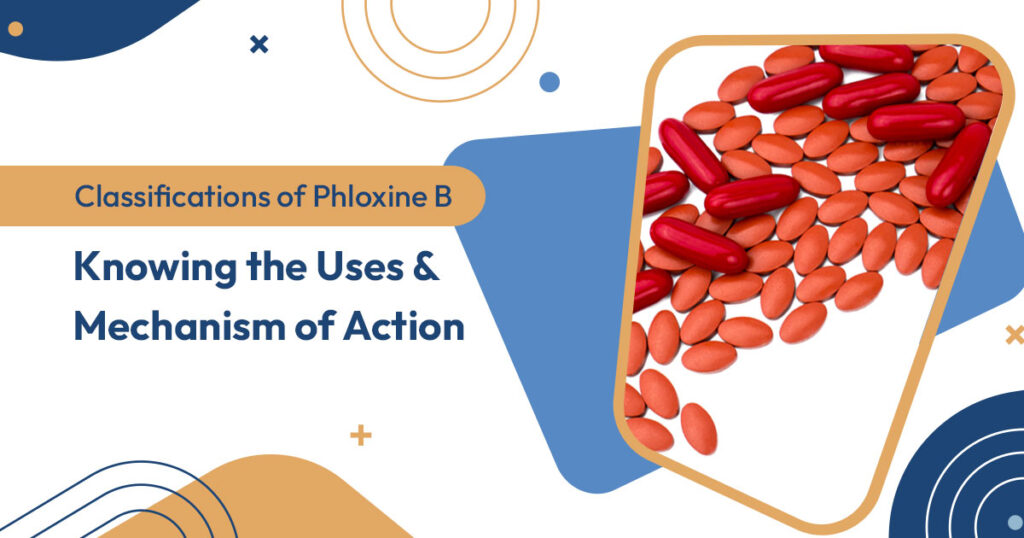
Phloxine B, or simply phloxine, also known as Acid Red No. 92 and D&C Red No. 28, is a color additive used as an inactive ingredient to impart color to certain substances or products and as a colorant in various dental disclosing tablets.
Phloxine B is a water-soluble red dye that is approved and permitted for use in coloring drugs and cosmetics in the United States and coloring foods in Japan. This blog will talk about Phloxine B (D&C Red No. 28) and help you understand the classifications, uses, and mechanism of action.
Phloxine B, or simply phloxine, is a derivative of fluorescein. However, it differentiates the presence of four bromine atoms at positions 2, 4, 5, and 7 of the xanthene ring and four chlorine atoms in the carboxyphenyl ring. This water-soluble dye has an absorption maximum of around 540 nm and an emission maximum near 564 nm.
Phloxine B is widespread as an antimicrobial substance & functions as a viability dye and biological stain. That means it could also be utilized in hematoxylin-phloxine-saffron (HPS) staining to color the cytoplasm and connective tissue in shades of red. If you are an industrial or enthusiastic chemist wondering what is phloxine B and its uses in different countries, this blog is for you.
Understanding Phloxine B
Phloxine B (commonly known simply as phloxine) is a water-soluble red dye used for coloring drugs and cosmetics in the United States and coloring food in Japan.
Phloxine B is a xanthene dye that is used as a photosensitizer in antimicrobial photodynamic therapy (APDT) to inhibit the growth of biocontrol agents and fungal infections, such as fungal keratitis, by preventing cell survival through light-induced damage.
Classification of Phloxine B
Phloxine B is also known as Phloxine or D&C Acid Red 92. The classification of Phloxine B (Acid Red No. 28) is based on a xanthylium dye and a xanthene dye. Xanthenes refer to organic compounds that are polycyclic aromatic containing a xanthene moiety, produced by combining two benzene rings united by a pyran ring.
Phloxine B is a red dye, classified as a fluorone dye, a xanthene dye that belongs to the xanthylium family of dyes:
- Fluorone: It is a classification for Phloxine B
- Xanthene dye: It is a classification for Phloxine B
- Xanthylium class of dyes: It is classified for Phloxine B
Uses of Phloxine B (D&C Red No 28)
Phloxine B or Phloxine is a red dye used as a color additive to provide color to foods, drugs, and cosmetics, providing a better and more appealing look. This water-soluble dye (Acid Red No.28) can also be used as an alternative to Gram staining to distinguish the difference between gram-negative and gram-positive bacteria.
In addition to this, there are various other uses of Phloxine B, including:
- Phloxine B or Phloxine is commonly used for coloring drugs & cosmetics in the United States.
- It is used as a color additive to provide colors to food & beverage items, including cakes, candy, biscuits, sausages, and confectionery products in Japan.
- Phloxine B could be used as a component of YEPD to grow Schizosaccharomyces pombe.
- To identify the cell ploidy and temperature sensitivity of Schizosaccharomyces pombe.
- Certified and approved for use in Mallory’s phloxine-methylene blue stain.
- Certified and permitted for use in Kreyberg’s method for keratin and mucus.
Additionally, Phloxine B is most commonly used for a variety of applications:
- Biological stain: It is most widely used in hematoxylin-phloxine-saffron (HPS) staining to connective tissue in shades of red and color cytoplasm.
- Drug and cosmetic coloring: For coloring cosmetics and drugs in the United States.
- Viability dye: It can also be used as a viability dye.
- Food coloring: It can be used for food coloring in Japan.
- Antimicrobial substance: Prevents the growth of biocontrol agents and fungal infections.
Phloxine B: Product Synonyms
Phloxin B; Phloxine; Phloxine P; CI Acid Red 92; Cyanosin; D&C Red No. 28; Acid Red 92; Disodium 2′,4′,5′,7′-tetrabromo-4,5,6,7-tetrachlorofluorescein; Eosin Blue; Eosine I Bluish; C.I. 45410.
Phloxine B: Chemical Properties
Here are the properties of Phloxine B:
- Chemical Formula: C20H2Br4Cl4Na2O5
- Molar Mass: 829.63 g·mol−1
- Appearance: Red to brown powder
- Solubility in water: Soluble
- CAS Number: 18472-87-2
- ChEBI: CHEBI:87192
- ECHA InfoCard: 100.038.490
- PubChem CID: 6433718
- UNII: 767IP0Y5NH
- InChI Key:GVKCHTBDSMQENH-UHFFFAOYSA-L
Phloxine B: Mechanism of Action
When phalloxine B is ionized in water, it becomes a negatively charged ion that attaches to positively charged parts of the cellular structure, which further requires citation. Upon exposure to phloxine B, bacteria die from oxidative damage. Phloxine B causes debromination and produces free radicals and singlet oxygen when exposed to light.
Furthermore, it causes permanent damage to the bacteria with these compounds that are prone to reduce growth and cell death. Gram-negative bacteria offer higher resistance to phloxine B because of the outer cell membrane that surrounds it. As a result of the polysaccharide coating, a permeability barrier is created, preventing the compound from being absorbed efficiently.
Through the addition of EDTA, which increases membrane permeability and removes lipopolysaccharides, the resistance to Phloxine B and gram-negative bacteria is removed more quickly and effectively. This polysaccharide-coated lipid bilayer creates a permeability barrier that prevents efficient uptake of the compound.
Conclusion
In the bottom line, it could be concluded that Phloxine B is broadly used in drugs and cosmetics in the United States and for coloring foods in Japan. Many leading companies today use this water-soluble dye, also known as Phloxine B for various industrial applications.
If you are a business and want more information on a wide range of applications of Phloxine B or require premium quality dyes or pigments for food, drugs, cosmetics, and home & personal care, look no further than Hridhan Chem.
Hridhan Chem is a leading manufacturer and exporter of premium-quality synthetic dyes and pigments in India, that offer 99.98% safety and efficacy following the U.S. FDA’s stringent safety measurements and quality standards. For more details on a Phloxine B or a diverse range of dyes and pigments, we produce at our manufacturing facility, get in touch with us today!
FAQs
Phloxine B forms negatively charged ions when ionized in water, binding to positively charged cells. Photobleaching of phloxine B results in the formation of singlet oxygen and free radicals.
Using Phloxine B staining, gram-negative and gram-positive bacteria could be distinguished optically, fluoroscopically, and optically confocally under normal room lighting.
Phloxine B has an absorption maximum of around 540 nm and an emission maximum of around 564 nm. In addition to industrial use, phloxine B works as a biological stain, viability dye, and antimicrobial substance.