Introduction
Color consistency is important in industries that use synthetic dyes. A small change in dye strength, purity, or composition can affect the final shade, product appearance, and manufacturing process. For buyers, manufacturers, and quality control teams, checking each batch helps reduce these risks.
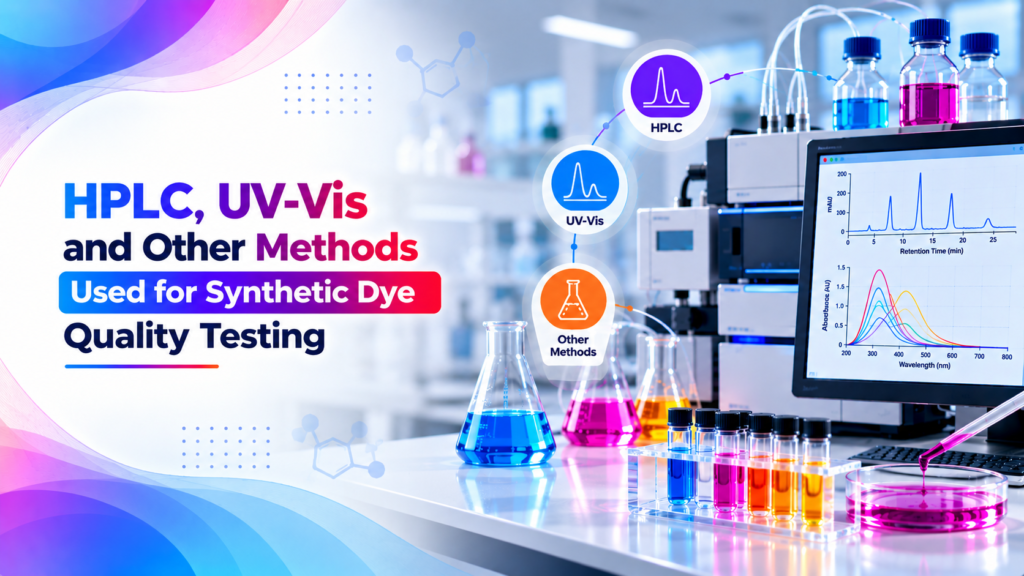
Synthetic dye quality testing uses several analytical methods to check a dye’s identity, color strength, purity, and specified impurities. High-performance liquid chromatography (HPLC) and ultraviolet-visible (UV-Vis) spectroscopy are two widely used techniques. Other methods, including thin-layer chromatography (TLC), mass spectrometry, and tests for moisture, ash, and heavy metals, may also be needed.
The right testing method depends on the dye’s chemical properties, intended application, and required specifications. No single test can confirm every aspect of dye quality.

1. HPLC Analysis of Synthetic Dyes
High-performance liquid chromatography (HPLC) is an important method for separating and measuring the components in a dye sample. It is particularly useful when a sample contains more than one color component or when manufacturers need to check for specific impurities.
During HPLC analysis, a prepared sample passes through a column with a liquid mobile phase. Different compounds move through the column at different rates and appear as separate peaks in a chromatogram.
What does HPLC test?
- Dye identity: Compare retention time with a suitable reference standard.
- Dye content: A validated method can measure the amount of a specified color component.
- Impurities: The method can help detect and measure certain related compounds or subsidiary colors.
- Batch consistency: Results can be compared across production batches.
HPLC with a UV or diode-array detector (DAD) is commonly used to analyze synthetic food colors. However, retention time alone does not always identify a compound. Reference standards, spectral information, and additional confirmation may be required.
For a food dyes manufacturer, HPLC can support routine quality control when the method is suitable for the specific dye and sample. The same principle applies to cosmetic dyes, although the required specifications and permitted uses may differ.
2. UV-Vis Spectroscopy for Dye Testing
Ultraviolet-visible spectroscopy measures how much ultraviolet or visible light a dye solution absorbs at different wavelengths. Because many synthetic dyes absorb light strongly in specific wavelength ranges, this technique is useful for routine analysis.
The wavelength at which a dye absorbs most strongly is often called its maximum absorption wavelength, or λmax.
What does UV-Vis measure?
- Absorbance: Measures how much light the sample absorbs.
- Concentration: Can estimate dye concentration using a suitable calibration curve.
- Spectral profile: Helps compare a sample’s absorption pattern with a reference.
- Batch variation: Can identify differences in absorbance under controlled test conditions.
UV-Vis is generally faster and simpler than chromatographic analysis. It is useful for checking color strength and monitoring production batches.
However, different compounds can have similar absorption spectra. Other ingredients, impurities, pH, solvent choice, and sample concentration can also affect results. UV-Vis alone may not reliably distinguish a pure dye from a mixture of similar-colored compounds.
For this reason, laboratories often use UV-Vis alongside HPLC when they need more specific information.
3. Thin-Layer Chromatography (TLC)
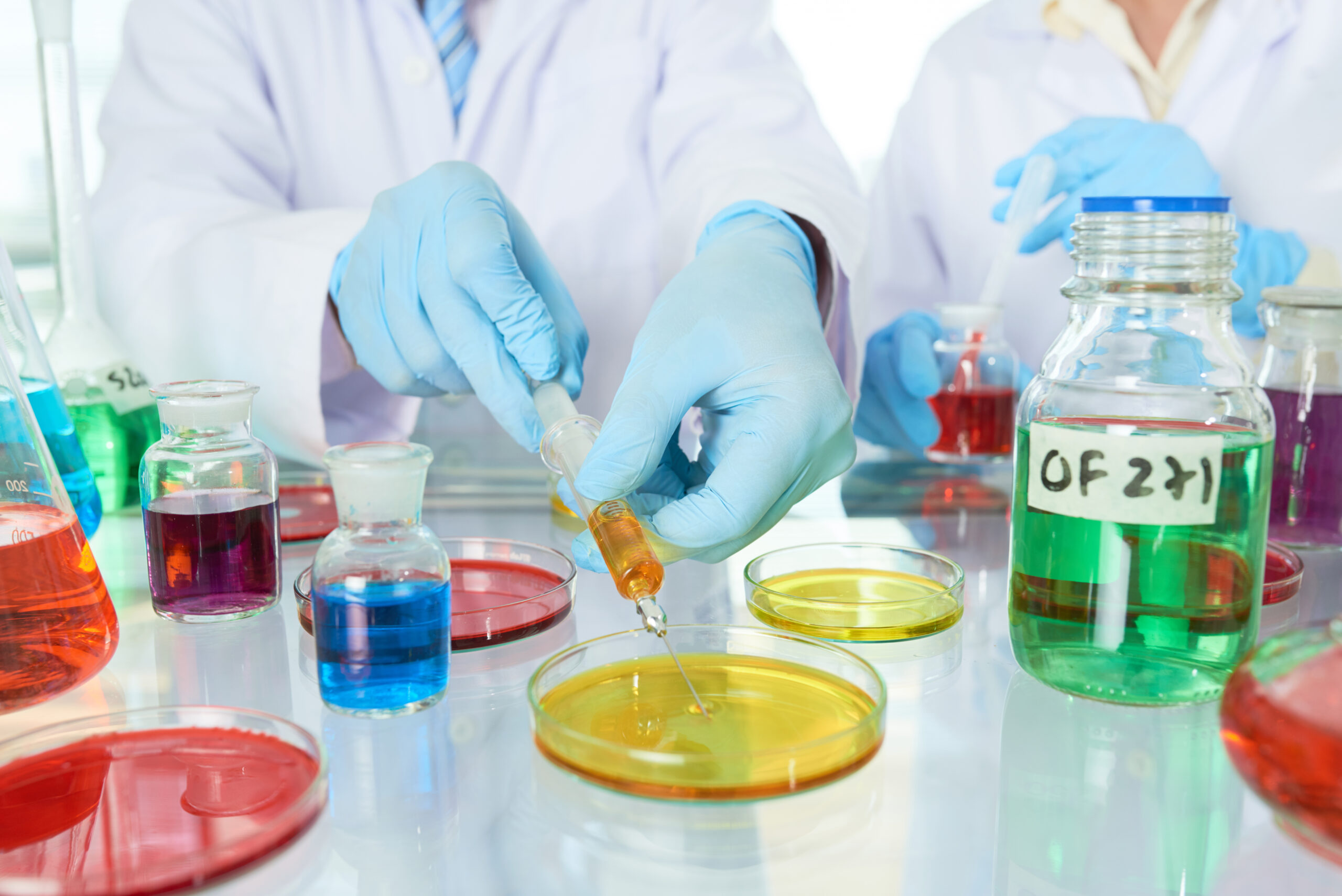
Thin-layer chromatography (TLC) is a simple method for separating sample components. A small amount of the prepared sample is placed on a coated plate and then developed in a suitable solvent.
Different components travel different distances, producing separate spots.
TLC can help with preliminary dye identification, checking for multiple color components, and comparing samples with reference materials. It is useful when a laboratory needs a straightforward screening method.
Its main limitation is that TLC generally provides less precise quantitative information than a validated HPLC method. A spot at a similar position is not conclusive proof of identity, so that further testing may be needed.
4. LC-MS and Other Confirmatory Techniques
Liquid chromatography–mass spectrometry (LC-MS) combines liquid chromatography separation with detection based on the mass-to-charge ratio of ions. It can provide stronger evidence of a compound’s identity than retention time alone.
LC-MS may be useful when a laboratory needs to investigate unknown impurities, confirm a suspected compound’s identity, or detect certain substances at low concentrations.
Other methods can support dye quality testing:
- FTIR spectroscopy: Helps identify chemical functional groups and compare materials with suitable references.
- Moisture testing: Measures water content, which can affect the dye’s measured strength and handling.
- Ash testing: Measures inorganic residue remaining after a specified heating procedure.
- Heavy metal analysis: Methods such as ICP-MS or atomic absorption spectroscopy can measure specified metals when required.
- Solubility and pH testing: Checks behavior under defined conditions relevant to product preparation and use.
Not every dye requires every test. The analytical plan should reflect the material, known manufacturing risks, customer specifications, and applicable regulations.
5. Why Sample Preparation and Method Validation Matter
Even an advanced instrument can produce unreliable results if the sample is prepared incorrectly or the method is unsuitable.
Before testing, the laboratory may need to dissolve the dye, adjust the pH, remove particles, extract the target compounds, or reduce interference from other ingredients.
A reliable analytical method should be assessed for:
- Accuracy: How closely the result matches an accepted reference value.
- Precision: Whether repeated tests produce consistent results.
- Specificity: Whether the method can measure the target compound in the presence of other substances.
- Linearity and range: Whether the method gives suitable results across the intended concentration range.
- Detection and quantification limits: The lowest levels that can be detected or measured reliably for the method.
Recovery studies and appropriate reference standards are also important, especially when testing complex samples such as finished foods or cosmetic formulations.
A method developed for a dye powder may not work equally well for a colored beverage, cream, or other finished product. Sample preparation and validation must account for the sample matrix.
6. How Manufacturers Use Dye Quality Testing
For synthetic dye manufacturers, quality control starts with defined raw-material and finished-product specifications. Testing can help confirm that a batch meets agreed requirements before release.
A practical quality control plan may include:
- Identity testing to confirm the dye is as expected.
- Assay or color content testing to measure the specified color component.
- Impurity testing based on the material’s specification and risk profile.
- Physical and chemical checks such as appearance, moisture, solubility, or pH, where applicable.
- Application testing to assess shade, compatibility, and performance under relevant conditions.
A cosmetic dyes manufacturer may need to consider the dye’s intended cosmetic use, formulation compatibility, and applicable restrictions. A food dyes manufacturer must also address the requirements for the relevant food color additive and its intended use.
For buyers comparing dyes manufacturers in India, useful questions include which analytical methods are used, whether they are validated for the specific dye, which batch parameters appear on the certificate of analysis (COA), and whether results can be traced to the supplied lot.

Conclusion
HPLC, UV-Vis spectroscopy, TLC, and LC-MS each serve different purposes in synthetic dye quality testing. UV-Vis is useful for routine absorbance and concentration measurements, while HPLC separates and quantifies individual components. LC-MS can provide additional evidence when more detailed compound identification is needed. Physical and chemical tests complete the picture where required.
The best testing strategy is not necessarily the one that uses the most instruments. It is the one that provides reliable evidence for the dye’s identity, content, impurities, and intended performance against defined specifications.
Looking for a reliable synthetic dye supplier? Contact Hridhan Chem to discuss your application, product requirements, and quality documentation. Our team can help you identify the relevant product specifications for your intended use.
FAQs
HPLC is often suitable for separating and measuring dye components and certain impurities. The best method depends on the dye’s chemistry, the impurities of concern, and the applicable specification.
HPLC separates the components of a sample before measurement. UV-Vis measures light absorption and is useful for concentration testing and spectral comparison, but it may not distinguish similar compounds in a mixture.
UV-Vis can support dye identification by comparing absorption spectra with a reference. However, similar spectra can occur for different compounds, so additional tests may be necessary.
Depending on the dye and applicable requirements, testing may include identity, color content, subsidiary colors, specified impurities, moisture, residual salts, and heavy metals. The required tests depend on the relevant specification and regulatory category.
Buyers should review product specifications, batch-specific COAs, appropriate analytical methods, traceability, consistency between batches, and documentation relevant to the intended application. Regulatory compliance should be verified separately for the product’s intended market and use.
No. A dye may meet its chemical specifications but still be unsuitable for a particular application. Permitted uses, exposure, formulation, and market-specific regulations must also be considered.