Introduction
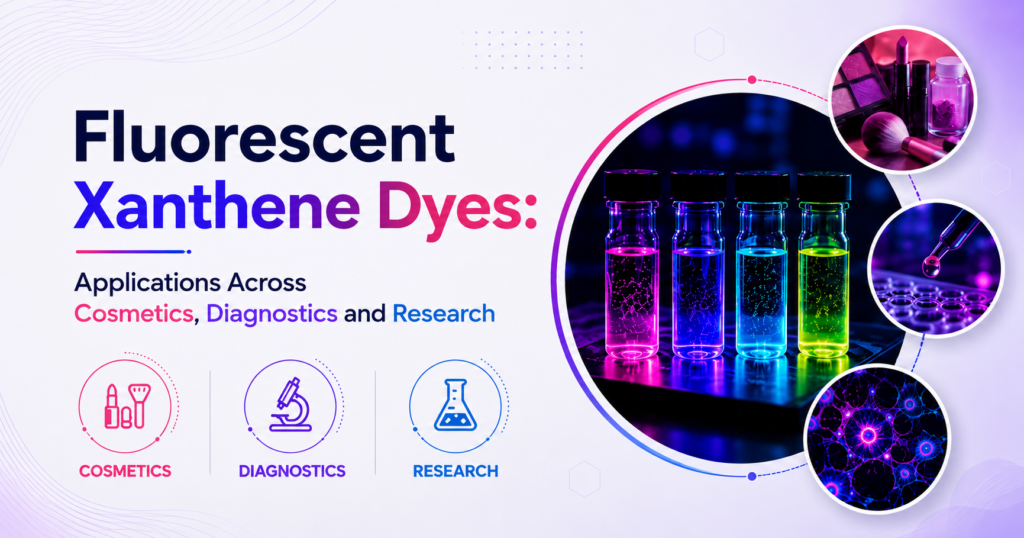
Walk into almost any chemistry lab, eye clinic, or cosmetics manufacturing facility, and you’ll likely find a xanthene dye in use. This family of synthetic dyes is well known for one remarkable property—it fluoresces. Under ultraviolet (UV) or blue light, xanthene dyes emit brilliant shades of green, yellow, orange, or pink, making them valuable across industries ranging from medical diagnostics to scientific research.
However, “xanthene dye” does not refer to a single chemical. It represents a family of compounds, each with different chemical properties, approved applications, and regulatory requirements. While some members, such as eosin, are approved for specific cosmetic applications, others, such as rhodamine B, are prohibited in foods and cosmetic products in many countries despite remaining important industrial and laboratory dyes.
Understanding these differences is essential for manufacturers, formulators, researchers, and buyers seeking compliant raw materials.
What Are Fluorescent Xanthene Dyes?
Fluorescent xanthene dyes are synthetic organic dyes built around a xanthene ring structure. Their molecular structure enables them to absorb light at one wavelength and emit light at another, creating intense fluorescence.
This property makes them ideal wherever high visibility or fluorescent detection is required.
Some of the most widely known fluorescent xanthene dyes include:
- Fluorescein – bright yellow-green fluorescence widely used in ophthalmology and biological research.
- Eosin – pink-red fluorescent dye used in pathology and selected cosmetic products.
- Rhodamine B – brilliant pink dye used mainly in textiles, industrial applications, and scientific research.
- Erythrosine – iodine-containing xanthene dye historically used in foods, pharmaceuticals, and cosmetics, with regulations differing by country.
Although these dyes belong to the same chemical family, their approved uses vary considerably depending on toxicity data and regional regulations.
Applications in Cosmetics
The cosmetic industry uses only selected fluorescent xanthene dyes that have been evaluated and approved by regulatory authorities.
Eosin
Eosin is marketed under cosmetic color additive names such as D&C Red No. 21 and D&C Red No. 22 in the United States.
It is approved for use in specific cosmetic products, particularly:
- Lipsticks
- Lip balms
- Lip stains
- Certain external cosmetic formulations
One unique characteristic of eosin is that it reacts with proteins in the lips, producing a long-lasting staining effect rather than simply coating the surface. This property has made eosin an important ingredient in lip products for decades.
However, eosin is not approved for use around the eyes, and manufacturers must comply with applicable concentration limits and regulatory requirements.
Rhodamine B
Despite its brilliant fluorescent appearance, Rhodamine B is not approved for cosmetic use in many major markets, including the United States.
The dye has been associated with toxicological concerns, leading to restrictions in cosmetic formulations. Regulatory agencies have also taken enforcement actions against products containing undeclared Rhodamine B.
Additionally, authorities in India have repeatedly prohibited its illegal use in sweets, beverages, spices, and other food products because it is an industrial dye rather than a food-grade color.
Its legitimate commercial applications remain primarily in:
- Textile dyeing
- Paper coloration
- Printing inks
- Laboratory research
- Fluorescent tracer studies
Applications in Diagnostics
Fluorescent xanthene dyes have become indispensable tools in modern medicine because their fluorescence allows physicians and researchers to observe tissues, blood vessels, and cells with exceptional clarity.
Fluorescein
Fluorescein sodium is one of the most widely used fluorescent diagnostic agents worldwide.
Major medical applications include:
Ophthalmology
Eye specialists use fluorescein for:
- Fluorescein angiography to visualize retinal blood vessels.
- Detecting corneal abrasions.
- Diagnosing dry eye syndrome.
- Identifying foreign bodies or surface damage.
Because fluorescein fluoresces under blue light, it enables doctors to detect abnormalities that may not be visible under normal examination.
Surgical Guidance
Special formulations of fluorescein are also used during certain neurosurgical procedures to improve visualization of tumors and tissue boundaries under specialized operating microscopes.
Eosin
Eosin is equally important in pathology laboratories.
It forms part of the globally recognized Hematoxylin and Eosin (H&E) staining technique.
In this staining process:
- Hematoxylin stains cell nuclei blue-purple.
- Eosin stains cytoplasm, connective tissue, and extracellular proteins pink to red.
H&E staining remains the gold standard for examining tissue biopsies and diagnosing numerous diseases.
Applications in Research
Fluorescent xanthene dyes are widely used throughout biological, chemical, pharmaceutical, and environmental research because they produce strong fluorescence even at extremely low concentrations.
Fluorescent Labeling
Scientists attach fluorescein and rhodamine derivatives to:
- Antibodies
- DNA
- RNA
- Proteins
- Peptides
- Cells
These fluorescent labels allow researchers to monitor biological processes using:
- Fluorescence microscopy
- Flow cytometry
- Confocal microscopy
- Immunofluorescence techniques
Environmental Tracing
Rhodamine B and related fluorescent dyes are commonly used as tracer dyes for:
- River flow studies
- Groundwater movement
- Pipeline leak detection
- Water distribution analysis
- Hydrology research
Their intense fluorescence enables scientists to detect extremely small concentrations over long distances.
Industrial Applications
Certain xanthene dyes are also used for:
- Textile dyeing
- Paper coloration
- Printing inks
- Security marking
- Industrial leak detection
Unlike food or cosmetic applications, these industrial uses generally involve different purity standards and regulatory requirements.
Why Country-Specific Regulations Matter
One of the biggest misconceptions about fluorescent xanthene dyes is assuming that approval in one application or one country automatically permits use everywhere. In reality, regulations vary by both intended use and geographic market.
Erythrosine
Erythrosine (commonly known as FD&C Red No. 3 in the United States) illustrates how regulations can evolve over time.
Historically, it was approved for use in foods, pharmaceuticals, and cosmetics in several countries. However, regulatory agencies have continued reviewing its safety based on emerging scientific evidence.
For example:
- The U.S. FDA announced the revocation of authorization for FD&C Red No. 3 in foods and ingested drugs in 2025, providing manufacturers with transition periods to reformulate products.
- Some countries continue permitting certain applications under specified concentration limits.
- Cosmetic regulations also differ depending on product category and region.
Manufacturers should therefore verify current local regulations before exporting or formulating products containing erythrosine.
Rhodamine B
Rhodamine B presents an even clearer regulatory distinction.
It remains widely used for:
- Textile dyeing
- Scientific research
- Industrial applications
- Fluorescent tracer studies
However, it is not approved as a food color and is restricted or prohibited in cosmetics in many jurisdictions due to toxicological concerns.
Regulatory authorities in India have repeatedly taken enforcement actions against products illegally colored with Rhodamine B, particularly sweets, spices, beverages, and street foods.
Similarly, international authorities monitor imported products to detect unauthorized use of industrial dyes in food and cosmetic products.
Why Compliance Matters
For manufacturers and formulators, compliance is more than meeting customer expectations—it is essential for legal market access.
Before selecting a fluorescent xanthene dye, companies should verify:
- Country-specific approvals
- Intended application
- Purity requirements
- Regulatory documentation
- Product labeling obligations
Working with experienced dye manufacturers and suppliers helps reduce compliance risks while ensuring consistent product quality.
Conclusion
Fluorescent xanthene dyes are an important family of synthetic dyes used across medicine, scientific research, industrial manufacturing, and selected cosmetic applications. Their exceptional fluorescent properties make them valuable tools wherever visibility and detection are essential.
However, these dyes should never be treated as interchangeable. Each member of the xanthene family has its own approved applications, safety profile, and regulatory status.
For example:
- Eosin is widely used in pathology laboratories and approved cosmetic lip products.
- Fluorescein plays an essential role in ophthalmology, medical diagnostics, and biological research.
- Rhodamine B remains valuable in textiles, industrial processes, and laboratory applications but is not approved for food use and faces significant cosmetic restrictions.
- Erythrosine continues to undergo regulatory review in several jurisdictions, highlighting the importance of monitoring changing legislation.
Manufacturers, distributors, and buyers should always source fluorescent xanthene dyes from reputable suppliers capable of providing appropriate quality certifications and regulatory documentation for the intended market.
Understanding the differences among these dyes helps ensure product safety, regulatory compliance, and successful commercial applications.
FAQs
Fluorescent xanthene dyes are synthetic organic dyes that emit bright fluorescent colors when exposed to ultraviolet or blue light. Common examples include fluorescein, eosin, rhodamine B, and erythrosine.
Only selected dyes are approved for cosmetic use. Eosin (D&C Red No. 21 and D&C Red No. 22) is approved for certain cosmetic products such as lipsticks in some countries. Other dyes, including Rhodamine B, are generally not approved for cosmetic use.
Fluorescein is primarily used in:
- Eye examinations
- Fluorescein angiography
- Detection of corneal damage
- Biological research
- Fluorescent labeling
- Certain surgical procedures
Rhodamine B is considered an industrial dye rather than a food-grade or cosmetic-grade colorant. Toxicological concerns have resulted in restrictions or prohibitions for food and cosmetic applications in many countries, although it remains valuable in industrial and scientific applications.
Eosin is a key component of the Hematoxylin and Eosin (H&E) staining technique used worldwide. It helps pathologists visualize tissue structures, making disease diagnosis more accurate.